concept: a game called “john mulaney or cecil palmer?” where you have to guess if a quote was said by popular stand-up comedian john mulaney or fictional radio host cecil gershwin palmer
this might sound easy, but please keep in mind that john mulaney has
said “whoa, that tall child looks terrible! get some rest, tall child!
you can’t keep burning the candle at both ends!” and cecil palmer has
said “alligators: can they kill your children? yes.”
John has said “🎶Because we’re Delta Airlines, and life is a fucking nightmare! 🎶” and Cecil has said “Delta Airlines, because it’s not like you’re safe anywhere else.”
I feel like a lot of abortion debates are becoming based on feelings, emotions, and subjective morality. I’m not looking for an ugly knock out drag out debate, i just want to discuss hard facts about abortion and see where this goes.
The fetus relies fully on the body it is inside of to maintain it’s survival and function, thereby requiring that persons continuous consent to remain there, as the right to security of person was deemed more important that a right to life as seen in the supreme court cases in the USA of Roe V. Wade and McFall V. Shimp (In Canada the two cases that did this were Morgentaler, Smoling, and Scott v. Queen and Daigle V. Trembley).
The fetus does not have the capacity for conscious, purposeful, or controlled movement. All movement that a fetus makes is fully involuntary, and happen as a result of the nervous system forming, testing itself out, and testing limb movement in order to ensure everything is in place to ensure survival capability after birth -assuming it survives the pregnancy and birth. In fact, the first sparks of consciousness in homo sapiens happens at 5 months AFTER birth.
Lack of safe abortion access KILLS. An estimated 68,000 people per year die because of lack of access to safe abortions, and a uncounted millions are left with permanent health issues as a result. That’s an estimated 186 people who will die TODAY because they did not have safe access to an abortion. There are an estimated 19 million unsafe and illegal abortions performed annually.
Most abortions are NOT performed on teenagers who were sleeping around and did not use protection. The largest groups recieving abortions are ages 20-24 (33% of all abortions), non-hispanic white (36%), religious(37% identify as protestant and 28% identify as catholic, meaning over half of abortion recipients follow a sect of Christianity) , married or cohabiting (55%), have one or more children (61%), used protection (51%) and are below the poverty line (42% are 100% below the poverty line, and a further 27% are 100-199% below the poverty line. 69% of abortion recipients are below the poverty line). (source)
And finally there is the fact that organs, does not a person make. Most things on this planet have organs. Birds have organs, bees have organs, dogs, lions, bears, pigs, cows, and even individual cells have organs or organ-like components that keep them alive. The fetuses development level does not grant it rights because that is not how we grant rights.
Those are the cold, hard facts on abortion. Those are the facts pro choicers have presented a thousand times to you and countless other pro lifers like you. Those are the facts that your group has ignored over and over again in favour of proven misinformation. I have no doubt there will be no response to this, and if there is you will give me lifenews or some other equally biased site as a “source”, despite my giving you only unbiased ones. If you want to discuss the facts on abortion you can’t use websites that are based in lies.
Anyone who tells me women shouldn’t have access to safe abortions can get drop-kicked in the face. You don’t have to agree with someone’s choice – respect it, stay quiet, and move on. Did it personally effect your quality of life? I hardly doubt it. It’s 2018 people. Wake the fuck up.
Okay, I hate to get apart of these discussions, but I gotta talk here.
I’m an abortion survivor.
At the first (maybe second?) Ultrasound, the doctors pulled my parents aside and said that I was a trouble baby, that there was an 80% chance that I would have several crippling diseases, that there was a chance that I wouldn’t live past my first year, that the birth would probably be painful and dangerous for my mom, who was already nearly too old to have children and had already had two c-sections, drastically increasing her risk of hemorrhaging to death.
The doctors recommended abortion. Strongly.
I’m sure you can guess what my mom said.
No.
She didn’t care that I would never know. She didn’t care that she might die. She didn’t care that she might only have me for a year. She didn’t care that I might not be the happy, healthy child that she had hoped for.
She didn’t care.
Cuz my mom’s the most selfless person I know.
And guess what?
I was fine.
Yeah, I have neck and back problems and CM and MVA and a crap ton of other problems, but I still thank my mom every kriffing day for not aborting me. Because she decided to risk her life instead of having a “safe” abortion, I graduated at the age of 15, scored in the 95th percentile of my state, won a full ride scholarship to college, am a sophomore student with honors, and I just got an invitation for an internship in NYC.
Call me proud, bragging, boastful, privileged, or any other shitty words, but until you can convince me that maybe I shouldn’t have existed, you can kiss my ass.
And look, @iidigestive-readerii , I don’t want there to be a quarrel between us. Even friends can have their differences, but I want the differences–and the reasons why they exist–to be clear.
Your mother had that option. She had the option to make a choice. The doctors presented her with the facts of her pregnancy, and she did what she thought was best. That’s what pro-choice people want– for people to be able to make a choice about their pregnancy.
Your existence is not an argument for making abortions illegal or for their immorality- if anything, your existence is an argument for informed choices, for prenatal screening, and for strong support systems that help both mother and baby. If your mom didn’t have access to prenatal screenings, if your mom didn’t have those options, do you think she would have been as informed about the potential challenges of raising you? Knowing and accepting the risks means you get to prepare for them. You get to make yourself mentally ready for possible challenges, and they don’t surprise you when they pop up after birth. Don’t you think that robust prenatal and postnatal healthcare and support made it easier to give birth with all these potential problems? Without the option to legally and safely abort, prenatal screenings are much less useful- and it sounds like your mom was in a pretty good situation to begin with, other than you being a risky pregnancy. And that’s what you were, a risky pregnancy. You are not an abortion survivor. If your mother had gone through an abortion procedure and Fetal You had survived, you’d be an abortion survivor, but your mom chose to carry you to term. That makes you a successful pregnancy. That makes you her baby. But an abortion survivor? Nah.
Nobody’s saying “you shouldn’t exist.” Even you’re just saying that your mother had the option to abort and didn’t. Does that make the option a bad one? No. Being pro-choice is about the choice itself. Not everybody’s as lucky as your mother- from just the snippet of story up there, it’s pretty obvious that she had a strong support system (your father) and was receiving regular medical care. That’s not the case for a lot of women.
Also: anecdotes aren’t data. Your story is anecdotal, a best-case scenario. Your story is the story of a woman who clearly had access to medical care and support, and who was part of a family that supported her decision as well. But your story doesn’t contradict the facts or even provide strong evidence that abortion is immoral or should be illegal- it just shows that in one very specific case, a woman’s choice not to abort turned out really well for the child (and I’m assuming your mother, I bet she’s very happy with you- you’re obviously really accomplished and I bet she loves you a lot).
This is my masters’ degree in anthropology. I’d show you my BA, but it’s at my parents’ house. I’m three and a half years into a PhD in physical anthropology. I’ve been employed to do physical anthropology at one of the world’s best natural history museums. My area of study? Teeth and diets. I’m not here to argue veganism or vegetarianism, I’m here to tell you, point by point, why you’re devastatingly misinformed about our place in the primate family tree, along with my peer-reviewed sources behind the jump. I know we live in a “post-truth” society so maybe being presented with the overwhelming consensus of the scientists who currently work with this material is meaningless to you, and honestly, this probably isn’t going to make a bit of difference for you, but I can’t let this slide. Not in this house built on blood and honor. And teeth.
1. The evidence for being closely related to chimpanzees is vast and well-understood thanks to advances in DNA analysis. We share a huge amount of DNA with them, and not just repeating patterns in non-coding DNA. We have numerous genes that are identical and likely diverged around 7 million years ago, when Sahelanthropus tschadensis was roaming the earth. S. tschadensis was a woodland species with basal ape and basal human-line traits. The most notable was the positioning of the foramen magnum towards the central base of the skull and not emerging from the back suggests bipedality. This, along with other traits such as small canines worn at the tip, which implies a reduced or absent C/P3 honing complex (the diastema), suggests that this is actually a basal trait and the pronounced diastema we see in other species was a trait that came later. But more on that later- back to chimps and what we mean by sharing DNA. Our chromosomes and chimp chromosomes are structured far more like each other than other mammals. Furthermore, the genes located on these chromosomes are very similar. Chromosome 2, for instance, is nearly identical to two chimpanzee chromosomes. (Chromosome 2 in humans, Neanderthals, and Denisovans is different from Chromosome 2 found in apes and is actually the remnant of an ancient mutation where Chromosome 2 and 3 merged- you can see that from its vestigial centromeres and the genes found on it. We can’t get DNA from fossil material, but Neanderthal and Denisovan subfossils have demonstrated that this reduced chromosome count- we have one fewer pair than apes- is a typical trait of the Homo genus). Here’s a side by side comparison of Human and chimpanzee chromosomes.
Gene coding regions are colored- bands at the same place mean that there’s two identical genes at that locus. Our similarities to lemurs, on the other hand, aren’t on homologous chromosomes. We have similar coding around the centromeres but the genes express themselves differently. The structure of non-ape primate genes is also significantly different; when the first chromosomal comparisons were done between humans and lemurs back in the 1990s, it was discovered that lemurs have much more highly-concentrated heterochromatin at their centromeres, whereas the structure of human and chimpanzee centromeres is similar. The major differences in chimp and human DNA are in the noncoding regions; most of our genes have identical structures.
2. All primates evolved from a lemur-like organism, not just humans. Here’s one of them. I’ve seen her in person. Pretty cool, huh?
Her name is Ida and she’s a member of the genus Darwinius. But that’s just like saying all primates evolved from something that was basically a tree shrew- which is also true. See, one of the main points of evolution is that organisms are continually changing throughout time. We didn’t jump from lemur-like organism to human; changes were slow and gradual and the lineage isn’t really a straight tree. The fossil species we have and know lead to different lines branching out. Some things died off, some things flourished. Heck, look at the Miocene- twelve million years ago, there were hundreds of ape species. Now there’s twenty-three. (Sixteen gibbons, two chimp species, two gorilla species, two orangutan species, and one human species. There’s also some subspecies of gorilla and gibbon, but I’m only counting the primary species.) It’s hard to trace things back, but saying that we evolved from lemur-like species is obtuse and obfuscates the real point, which is that Homo and Pan descended from a relatively recent-in-the-grand-scheme-of-things common ancestor.
3. Our dentition is unique to the extant primates, but not australopithecines. Our teeth look very much like other members of the genus Homo, the extinct ones, as well as many of the australopithecines. We also have very similar enamel proportions to gracile australopithecines; apes have much thinner enamel overall.
But what did australopithecines eat?
Everything. We know they were eating fruits and nuts based on microwear analysis and strontium analysis, but we also know they were eating meat- and in pretty decent quantity, too. We’ve found all kinds of butchering sites dating back millions of years and in association with Australopithecus garhi, the earliest tool user, but we can also see this in tapeworm evolution. There’s many, many species of tapeworm in several genera. But three of them, in the genus Taenia, are only found in humans. And these species diverged from… carnivore tapeworms. Their closest relatives infect African carnivores like hyenas and wild dogs.
Tapeworms that are adapted to the specific gut of their host species need a certain environment, as well as a specific cycle of infection so that it can reproduce. A tapeworm that infects hyenas is going to be less successful if it somehow makes the jump to a horse. But if the hyena tapeworm was able to adapt to our gut, that suggests that our stomach was hospitable enough for them chemically to survive- which brings me to the intestines.
4. Our intestines are also unique. Yes, we have longer intestines than carnivores, but we also don’t have cecums like herbivores. We are omnivores and that means we still needed to retain the ability to digest plants.
The key to being omnivores is omni. All. I’m not saying we should only be eating meat, I’m saying our ancestors ate a varied diet that included all kinds of things. If we weren’t omnivores, why would we have lost the cecum’s function? Why is the human appendix only a reservoir for the lymphatic system, as it is in carnivores? The cecum is an extremely important organ in herbivores, as it houses the bacteria needed to break down cellulose and fully utilize fiber from leaves. But we don’t have that. Instead, we compensate with a long gut. Our ancestors absolutely did eat fruits and nuts and berries, but they also ate other stuff. Like scavenged carcasses and bugs and probably anything they could fit in their mouths. Which- actually, primate mouths are interesting. Humans and chimpanzees have enclosed oral cavities, thick tongues, and jaw angles much more like herbivores than carnivores- suggesting a herbivorous ancestor. That’s not something I’m arguing against at all. But again, we have adaptations for eating meat and processing animal protein because we are an extremely opportunistic species.
5. Our canines are true canines. First, semantics: having a diastema does not canine teeth make. We refer to the canine teeth by position- even herbivores, like horses, have them. They’re the teeth that come right after the incisors. All heterodonts have the potential same basic tooth types- incisors, canines, premolars, molars- in various combinations and arrangements. Some species don’t have one type of teeth, others don’t have any- but it’s silly to say that the canine teeth aren’t canine teeth just because they don’t serve the same function as a gorilla’s or a bear’s or some other animal’s. It’s basic derived versus primitive characteristics.
Now that we’ve got semantics out of the way, let’s talk about that diastema. The lost diastema is a derived trait, which means that our ancestors had it and we lost it over time. All other extant non-Homo primates have a canine diastema. All of them. However, when you look at australopithecines, we see that many of them either don’t have it or have it in a reduced capacity. At the earliest known hominin site, Lukeino, we see Orrorin tugenensis with reduced canines compared to ape fossils and modern apes- and… you do know that apes don’t use their canines for eating meat, right? Like, primate canines serve a very different purpose than carnivorans’ canines. It’s suggested that the large canines are for social display moreso than anything dietary- bigger, more threatening teeth are useful if you’re a gorilla or chimpanzee fighting to the top of your group’s social structure.
I’m going to refer you to a blog post written by Dr. John Hawks, a good friend of my advisor and generally a pretty cool guy. He’s got a nice writeup on the evolution of hominin teeth and how the human line’s teeth have changed through time.
Also, of course our teeth are going to be smaller. When we compare archaic Homo sapiens fossils to modern skeletons, their teeth and jaws are much more robust. This is likely related to the introduction of soft foods- and by soft, I mean cooked grain mush- to the diet around the time of domestication, right before the population explosion that happened about 10k years ago. In general, post-domestication human jaws are much smaller and more crowded than any other humans and hominins that came before.
6: Neanderthals did die out, but not in a catastrophic event like we think of with dinosaurs. While there are no living Neanderthals today that we would classify as Homo neanderthalensis, there is plenty of evidence that we interbred and likely outcompeted them as a species due to our overwhelmingly large population size (hypothesized based on number and locations of remains found). While there’s only a small percentage of Neanderthal mitochondrial DNA lines in human populations today, it’s quite likely we lost a lot of that due to genetic drift and population migration- Neanderthals, after all, had a much more limited range than Homo sapiens sapiens. Their eventual extinction is a mosaic of events- outcompetition plus assimilation. The line between Homo sapiens sapiens and Homo neanderthalensis/Homo sapiens neanderthalensis is blurry- there’s some physical anthropologists who actually think we should be including them within our species as a subspecies- but they are extinct in that the specific subset of hominins with distinct karyotypes and potential phenotypes no longer exists.
Me: So you remember in the ALTA finale when Aang gets slammed against a rock in JUST the right spot so his chakra is unblocked and it realigns his whole spirit & body and he is able to reach his full potential as the avatar?
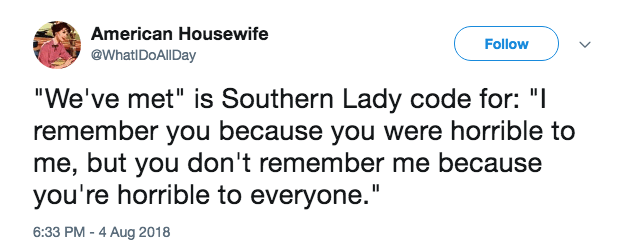
In which the spouse and I both realize we’re vindictive southern belles.
Oh I do this all the time in academia.
“we’ve met” is, as stated, usually acknowledgement of a one-sided grudge. The aggressor isn’t actually very likely to dignify this with a response stronger than the kind of willful amnesia that leaves god and everyone wondering what she’s playing at and what the victim did to deserve it.
“we’re acquainted”, on the other hand, means that these two Southern Ladies know each other for three generations and actively maintain open hostilities along multiple vectors. There is about to be blood shed in this O’Charleys at 2pm on a Sunday. The actual victim of gossip will be whoever did that introduction, because everyone knows that Mary and Louise have hated each other since 1951, and how did that person not know? You fool.


 vanhalenofficial