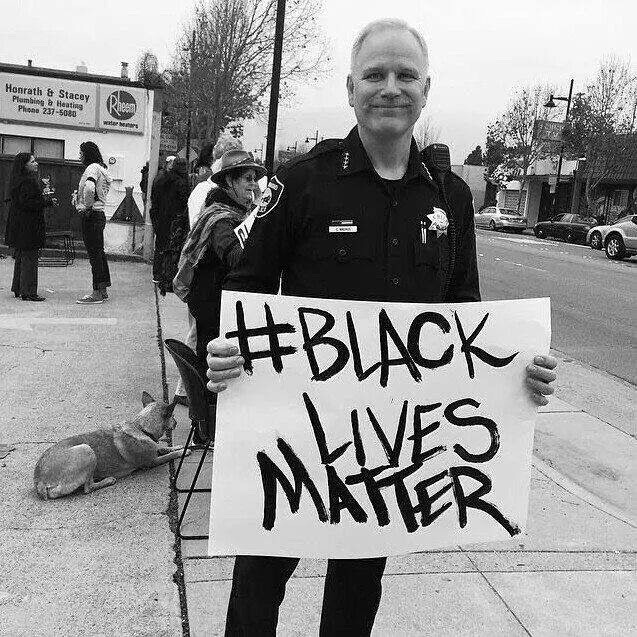
The man holding this #BlackLivesMatter sign is Richmond (CA) police chief Chris Magnus, whose department has not lost an officer or killed a citizen since 2007, the year after he took over. This is not an accident, this peacefulness is the direct result of his leadership. Police departments across the country should be looking to his department as an example to be followed.
‘Chief Magnus changed the department from one that focused on “impact teams” of officers who roamed rough neighborhoods looking to make arrests to one that required all officers to adopt a “community policing” model, which emphasizes relationship building.
“We had generations of families raised to hate and fear the Richmond police, and a lot of that was the result of our style of policing in the past. It took us a long time to turn that around, and we’re seeing the fruits of that now. There is a mutual respect now, and some mutual compassion.”’
They also do regular officer trainings with roleplay scenarios and airsoft guns to teach them how to de-escalate, how to avoid firing when fired upon, and how to deal with people with weapons in a way that doesn’t end with a shootout.
They also apparently go through the details of officer-involved shootings elsewhere, picking them apart and using them as teaching tools for what NOT to do or what the officer could have done to avoid shooting the person.
Essentially, they take a proactive approach to not shooting people and put time, money, and effort into it. Richmond isn’t a low-crime area. Other cities could follow their model and almost certainly see results.
Who’d have thought it would take so much work to learn how to just … NOT shoot people
These are the sort of police officers who deserve respect. The ones who take the time to build a relationship with the community they’re supposed to be protecting, and work to actually protect people instead of just shooting anyone who looked scary.
In before anyone tries to say that the only reason this works is because Richmond is probably like “not as bad” as other places in the US
I once said to my therapist after a particularly hard week, “I wish I could just fix all of my problems and move on to live a normal life”
And he looked at me and said, “There is no finish line”.
Those words felt like a stab in my heart, but they were words that I desperately needed to hear. There is no finish line to my problems. It’s not possible to get through a certain point in life and have my problems simply disappear. And it’s unhealthy to think that way. Up to that point in my life, that’s what I though recovery was. I thought it was like working your way forward until it seems like your problems never existed in the first place.
The finish line does not exist. Instead, everyone has a capacity for recovery. You may never completely rid yourself of whatever causes you pain, but you will move miles from where you started. Don’t set your expectations too high and create that theoretical finish line in your life, or you will only end up chasing it. Instead, focus on your own capacity for recovery, and be proud of yourself for every step you take.
Just saw Eighth Grade and reblogging the heck out of this bc wow it gets so much better if you just take it one step at a time
Okay but I cant help but hear “there is no finish line” and immediately respond with “then why am i running the race?” What is the point*? Where is the benefit of putting in the effort if its not going to ever end? If i am always going to battle I would rather just give up the fight.
*(Im not saying recovery is bad or whatever ppl wanna reach for, this is my personal view)
That’s the thing, though: it’s not a race. It’s a garden.
No matter what your garden looks like in the beginning, you have to weed it before it can grow into what you want it to be. And when your flowers are planted and growing, you still have to keep up with the weeding. You have to keep up with the weeding even after your flowers are tall. A garden can’t survive on its own. There will always be weeds.
But there will be flowers, too, if you give them space to grow. Give them room, give them time, and keep checking in to make sure the weeds don’t get too tall. You will always have weeds, but you will also have flowers.
And maybe your garden doesn’t look exactly like you imagined it would. Maybe you aren’t sure how to get rid of that one big thistle in the corner. Maybe you’ve got bindweed and nutgrass (which will always, always come back). Either way, you’ve got flowers now, and it’s a nice place to sit and look around, and it looks nicer than it did before, and it’s yours. Keep going with it. If you miss a few days, or months, or years, that’s okay. Pull up the weeds when you’re ready, uncover your old flowers and plant some new ones, and keep going.
Gardening is a process, not a project or a problem that can be solved. The same is true for your mental health. Weeds will grow, but you’ll get better and better at pulling them, and you’ll grow flowers, too.



























 vanhalenofficial